
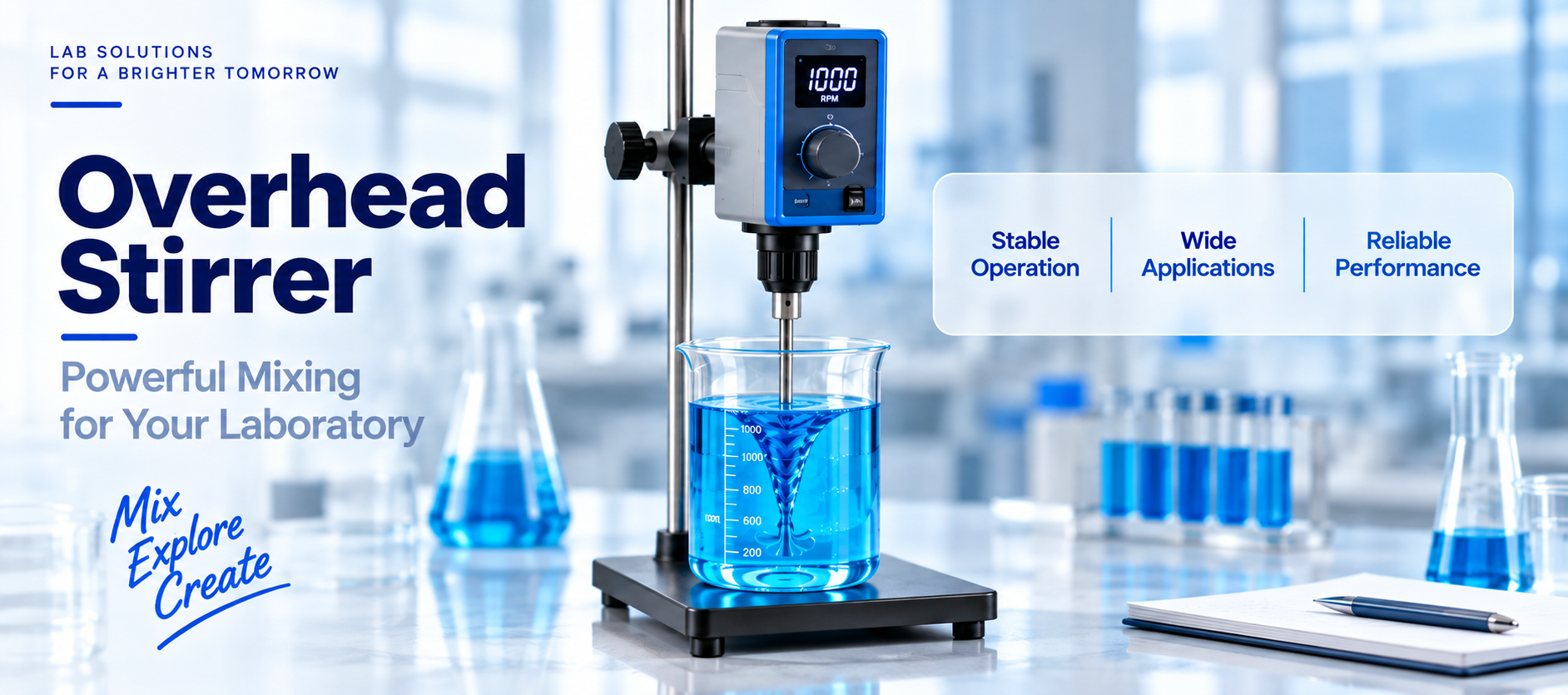
An overhead stirrer is a laboratory instrument designed for controlled and homogeneous mixing of liquids, particularly high-viscosity samples. A motor rotates a stirring shaft and impeller, applying mechanical force directly to the sample.
Overhead stirrers are particularly useful for high-viscosity, large-volume or dense mixtures where magnetic stirrers may not provide sufficient mixing performance.
How Does an Overhead Stirrer Work?
The motor rotates the stirring shaft at a selected RPM (revolutions per minute). The impeller attached to the shaft creates liquid movement and promotes homogeneous mixing.
Motor → Stirring Shaft → Impeller → Homogeneous Mixing
Mixing performance depends not only on speed but also on torque, viscosity, sample volume and impeller design.
Why Is Torque Important?
Torque is one of the most important parameters when mixing viscous or dense samples.
Low-viscosity liquids such as water generally require less torque, while creams, gels, polymer solutions and dense suspensions may require significantly higher torque.
Therefore, both maximum RPM and maximum torque (N·cm) should be considered when selecting an overhead stirrer.
Common Applications
Overhead stirrers are used for:
- Preparation of chemical solutions
- Mixing high-viscosity liquids
- Preparing suspensions and emulsions
- Polymer and resin applications
- Cosmetic creams and gels
- Paint and coating development
- Pharmaceutical formulation
- Food and beverage laboratories
- General R&D and quality control
Why Is the Impeller Important?
Different impellers create different flow patterns. Propeller, paddle, turbine and other designs can be selected according to the sample and application.
Some are suitable for rapid circulation of low-viscosity liquids, while others provide stronger mixing for more viscous materials.
Sample + Viscosity + Volume + Impeller Type
should therefore be considered together.
Overhead Stirrer vs. Magnetic Stirrer
A magnetic stirrer rotates a magnetic stirring bar inside the vessel. An overhead stirrer uses a motor-driven shaft and impeller immersed directly in the sample.
Overhead stirrers are generally better suited to higher viscosities, larger volumes and applications requiring greater torque, while magnetic stirrers are convenient for many low- to medium-viscosity applications.
What Should You Consider When Choosing an Overhead Stirrer?
Important parameters include:
Speed Range + Maximum Torque + Mixing Volume + Viscosity Capacity + Speed Control + Impeller Type + Shaft Compatibility + Safety Features
Conclusion
Overhead stirrers provide powerful and controlled mixing for demanding laboratory applications, particularly when working with viscous or larger-volume samples.
Selecting the right combination of speed, torque, viscosity capacity, volume and impeller is essential for effective mixing.


